
News
New film series shines a light on the global challenge of fungal diseases
15 October 2026
World-leading researchers, clinicians, policymakers and people with lived experience are sharing their perspectives in a new film series by the University of Exeter’s MRC Centre for Medical Mycology (MRC CMM).
The series of four videos brings together different aspects of the global fight against deadly fungal infections and antifungal drug resistance. The collection of short films, Stories Behind the Science brings together leading researchers, policymakers, healthcare professionals and people with lived experience to highlight the challenges of tackling fungal infections, and work happening around the world to address them.
The series includes insights into antifungal drug resistance, stories from people affected by aspergillosis and cryptococcal meningitis and perspectives from researchers working in South Africa and Latin America. Together, the films show how scientific discoveries, international collaboration, public health policies and lived experience all contribute to tackling this global health threat.
Dame Sally Davies, UK Special Envoy on Antimicrobial Resistance, who appears in the film Race Against Resistance, said: “Fungal diseases are a growing global health threat that remains too often overlooked. These films help bring the science and the human impact into focus, and highlight why we must act now.”
Professor Adilia Warris, Co-Director of the MRC CMM and Co-Lead of the Clinical Mycology Theme, NIHR Exeter Biomedical Research Centre, said:”Stories Behind the Science brings together the voices of people affected by fungal disease, of researchers dedicating their careers to medical mycology, and of clinicians treating patients with life-threatening infections. By sharing these different perspectives, we hope to increase awareness of fungal diseases and the impact on people’s health. Collaboration at every level and across borders is key to improve outcomes for patients around the world.”
Stories Behind the Science was supported by funding from the FAILSAFE project and the NIHR Exeter Biomedical Research Centre (BRC), and forms part of the MRC CMM’s public engagement programme. The films are available to watch on The Fungal Threat website and the MRC CMM YouTube channel.
View the original article and more here >

Soapbox Science
24 June 2023
Two members of the MRC CMM team recently took part in the Soapbox Science festival on Exeter Quayside. Soapbox Science is a global movement to give a platform for women and non-binary researchers to highlight their work to the public. Taking inspiration from Speakers’ Corner in London, scientists have to present their research with simple props and their voice – no laptops or PowerPoint in sight! This means that the participants have to come up with novel ways to engage the public audience.
Alison Gifford gave a talk on health inequalities and Cryptococcus, and Dr Liliane Mukaramera presented about the good and bad fungi that live all around us.
Here Alison tells us about her experience giving a presentation at the event:
“I am a first year clinical PhD student studying a fungus called Cryptococcus which is the most common cause of meningitis in sub-Saharan Africa. I am also a trainee Paediatric doctor and am passionate about global child health inequalities.
I applied to Soapbox Science because I loved their ethos on bringing science to the public and promoting women in STEM. I am a working mum to three young boys and want it to be completely normal for them, and everyone else, to see women at the forefront of science and know that women are capable of doing anything that they want to do.
I spoke about the fungus Cryptococcus, how it can reach the brain to cause meningitis, and how this is diagnosed by doctors. I explained about the size of the problem in sub-Saharan Africa and that my PhD involved investigating the immune response within a child’s brain.
My audience seemed to start small and then grow larger and larger, with lots of people surprised at the extent of health inequalities in children and intrigued to how a fungus can be so deadly. I found communicating my research to the public immensely fulfilling and I would encourage other women to sign up next year!”
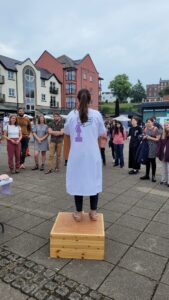
Alison giving her Soapbox Science talk
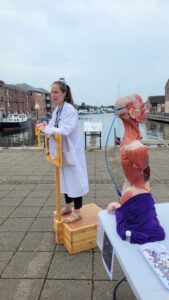
Alison and her ‘props’

Science Education Day at Kew Green Preparatory School
23 June 2023
It’s always exciting to leave the labs and venture into new places to talk about our research. On the 9th May 2023, Noah’s Pink Balloon Leukaemia Fund Fellow Dr Alyssa Hudson, Professor Adilia Warris and Rachel Etherington from the Medical Research Council Centre for Medical Mycology (MRC CMM) at the University of Exeter, travelled to Kew Green Preparatory School to do just that.
This school visit was a special one, as Noah Tesselaar was a pupil at Kew Green Preparatory School, when he developed leukaemia and died of an invasive fungal infection, mucormycosis, in June 2020. In July 2021, his parents founded Noah’s Pink Balloon Leukaemia Fund, with a focus on medical research to help alleviate the suffering of other children and their families. In 2022, the charity funded the Noah’s Pink Balloon Fellowship, based at the Medical Research Council Centre for Medical Mycology and Dr Alyssa Hudson was appointed to the position of Fellow.

Professor Adilia Warris introduces the Centre for Medical Mycology
Kew Green Preparatory School is actively fundraising for Noah’s Pink Balloon Leukaemia Fund this year, so it was a great opportunity to show the pupils and their teachers how their efforts have directly benefited Alyssa’s research into mucormycosis.
In the morning, year 6 pupils enjoyed being scientists as they explored the world of fungi and medical mycology. The students got a sneak peek inside the MRC CMM labs, and we discussed different species of fungi and their shapes and sizes, as well as the good and bad fungi. After a whistlestop tour of the fungal kingdom, and with great enthusiasm, the students carried out the ‘yeast balloons’ experiment, to prove that baker’s yeast is a living organism. Students mixed water and yeast with varying amounts of sugar, to see how much carbon dioxide would be produced by the yeast while consuming sugar, to inflate a balloon. There were a range of results, including one exploding bottle, which prompted excellent discussion and interesting questions.

Dr Alyssa Hudson talks to school pupils about her work.
In the afternoon, pupils from years 4-6 gathered in the hall for a science assembly with Dr. Alyssa, giving insight into her work as both a doctor and a researcher. Alyssa is a doctor in medical microbiology at the Royal Devon University Healthcare NHS Foundation Trust, and she explained how her work in the labs will benefit her work as a doctor, because her research is all about early diagnosis to better treat patients. The children were amazed at the microscopic images of fungi taken in the lab and horrified at the ‘hairy mould’ grown on agar plates! The pupils actively engaged with the presentation and it was fascinating to hear their ideas of what makes a good scientist, and what makes a great research team.

One of the experiments, showing yeast producing oxygen

Candida and Candidiasis conference, Montreal
23 June 2023
Candida and Candidiasis is a biennial meeting focused on studying all aspects of Candida biology. Candida is important because it causes disease ranging from superficial candidiasis to life-threatening systemic infection. In May 2023, hundreds of Candida biologists gathered in Montreal, Canada to present and discuss new findings in the field including genomics, epidemiology, infection, host response, drug resistance and therapeutics. Some hot-topics of the meeting included Candida auris, transcription factors involved in drug response and use of CRISPR technology throughout the field.
Candida and Candidiasis provided opportunity for many members of the MRC Centre for Medical Mycology to present their work including Emma Agnew and Laure Reis speaking in a Cell Biology session, Émer Hickey and Elena Rosseletti speaking in the Metabolism session and Jane Usher speaking in the Cutting Edge Approaches plenary session. During poster sessions, there were nine presentations ranging from Candida glabrata population genetics to fungal-bacterial biofilms.
The MRC CMM was able to support six attendees with travel grants, and the Ken Haynes Travel Bursary supported 12 attendances. Recipient of a Ken Haynes Travel Bursary, Seána Duggan, shared “the Ken Haynes Travel Bursary is a great support to early career researchers in networking with potential collaborators future colleagues”.

Exeter team in Montreal
This meeting was hosted by the Microbiology Society, the publishing arm of which currently invites manuscript submissions into a Candida Collection across all journals of the portfolio.

Breaking Convention event
15 May 2023
Authors – Orlando Ross, Sarah Newman and Jack Gregory
Walking up to the University of Exeter’s Streatham Campus, where the Medical Research
Council’s Centre for Medical Mycology is based, on Saturday 22nd April 2023, it was clear
that this would not be a normal day at university. Between Thursday to Saturday of this
week, Breaking Convention 2023 was being held across the campus. Breaking Convention
is a meeting of researchers, scientists, clinical specialists, enthusiasts, spiritualists, and
many more with one common connection: psychedelics.
The passes to attend the conference were printed on water paper, designed to look like LSD
tabs, the first signal that this would not be a normal conference. We started our day by
visiting the art installations which were tucked around a corner of the Forum. One exhibit
caught our eye; a “hypnagogic light experience”, where bright pulsating lights are flashed
above your head as you lie down and relax. Designed to simulate a psychedelic trip, with
no substance consumption, the experience was incredibly clever, whilst being energising,
and relaxing at the same time. So many colours, shapes and fractal patterns appeared
during this meditative state, and it was great to understand the adventure of a hallucinogenic
state in a safe and therapeutic way – these therapies are used for deep relaxation and allow
the user to return back to normality quickly and safely.
We then attended a slew of talks throughout the day, aimed and increasing awareness of
the benefits of psychedelics in clinical settings, such as MDMA-assisted therapy for PTSD
sufferers, or psylocibin (the hallucinogenic compound found in many naturally growing
mushrooms across the globe) use in therapies, alongside discussing the accessibility,
equitability, and legalisation of these substances.
Dr. Ben Sessa, co-founder of the convention and clinical researcher at Bristol, Cardiff,
and Imperial College London Universities, delivered a talk which focused on highlighting the
benefits of MDMA- assisted therapy for PTSD and alcohol dependence, whilst driving
de-stigmatisation in the UK and further afield. Highlighting recent changes to policy
around the globe, he announced that he will be moving to Australia, where psylocibin
and MDMA psychedelic therapy have been legalised.
The setting of these therapies is also incredibly important, with stringent training
programmes needed to ensure that the maximum benefit is experienced by patients:
“[MDMA therapy] doesn’t work if you go to Totnes and sit in a yurt…”.
Paul Stamets, a self-taught mycologist, star of Michael Pollan’s Netflix show ‘How to Change
Your Mind’, and prolific advocate of psylocibin (with over 900,000 followers on Instagram),
gave a rousing talk on the history and potential future of magic mushrooms. With the 3rd
most downloaded paper on Nature’s Scientific Reports in 2021, Stamets demonstrated the
potential benefits of ‘microdosing’ psylocibin alongside non-psychedelic fungi such as lion’s
mane supplements. This paper shows increased productivity and motivation, lower anxiety
and depression when taking the “Stamets stack” of psylocibin, lion’s mane mycelium and
vitamin B3.
We managed to grab Stamets for a conversation after his talk and asked him for any advice
on young mycologists entering the taboo world of psychedelic research. In response,
Stamets highlighted historical medical mycology research focusing on pathogenic mycoses
instead of also researching the benefits of mushrooms to human health; “Penicillium
chrysogenum produces penicillin, and that’s pretty much where it stops”. He went on to say
that the “higher fungi [are seen as] culinary without any use”. In our discussion, Stamets
encouraged younger generations to challenge this idea, to apply knowledge from
pathogenic research into further understanding the applications and uses of non-pathogenic
fungi, with the example of incorporating quorum sensing knowledge into proliferation of
psychedelic mycelium.
The day, and the convention, ended with a closing ceremony, where attendees participated
in a ritualistic meditation where we were guided through feeling the four elements; earth,
wind, fire and water, culminating in everyone singing David Bowie’s ‘Memory of a Free
Festival’. There was an afterparty, billed as a ‘psychedelic lightshow’, but that probably
deserves a blog post of its own…

One of the presentations

The authors with Paul Stamets.

Breaking Convention marketplace