
24 June 2023
Two members of the MRC CMM team recently took part in the Soapbox Science festival on Exeter Quayside. Soapbox Science is a global movement to give a platform for women and non-binary researchers to highlight their work to the public. Taking inspiration from Speakers’ Corner in London, scientists have to present their research with simple props and their voice – no laptops or PowerPoint in sight! This means that the participants have to come up with novel ways to engage the public audience.
Alison Gifford gave a talk on health inequalities and Cryptococcus, and Dr Liliane Mukaramera presented about the good and bad fungi that live all around us.
Here Alison tells us about her experience giving a presentation at the event:
“I am a first year clinical PhD student studying a fungus called Cryptococcus which is the most common cause of meningitis in sub-Saharan Africa. I am also a trainee Paediatric doctor and am passionate about global child health inequalities.
I applied to Soapbox Science because I loved their ethos on bringing science to the public and promoting women in STEM. I am a working mum to three young boys and want it to be completely normal for them, and everyone else, to see women at the forefront of science and know that women are capable of doing anything that they want to do.
I spoke about the fungus Cryptococcus, how it can reach the brain to cause meningitis, and how this is diagnosed by doctors. I explained about the size of the problem in sub-Saharan Africa and that my PhD involved investigating the immune response within a child’s brain.
My audience seemed to start small and then grow larger and larger, with lots of people surprised at the extent of health inequalities in children and intrigued to how a fungus can be so deadly. I found communicating my research to the public immensely fulfilling and I would encourage other women to sign up next year!”
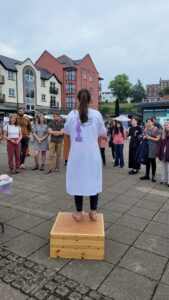
Alison giving her Soapbox Science talk
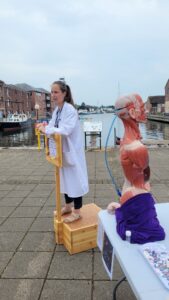
Alison and her ‘props’
23 June 2023
It’s always exciting to leave the labs and venture into new places to talk about our research. On the 9th May 2023, Noah’s Pink Balloon Leukaemia Fund Fellow Dr Alyssa Hudson, Professor Adilia Warris and Rachel Etherington from the Medical Research Council Centre for Medical Mycology (MRC CMM) at the University of Exeter, travelled to Kew Green Preparatory School to do just that.
This school visit was a special one, as Noah Tesselaar was a pupil at Kew Green Preparatory School, when he developed leukaemia and died of an invasive fungal infection, mucormycosis, in June 2020. In July 2021, his parents founded Noah’s Pink Balloon Leukaemia Fund, with a focus on medical research to help alleviate the suffering of other children and their families. In 2022, the charity funded the Noah’s Pink Balloon Fellowship, based at the Medical Research Council Centre for Medical Mycology and Dr Alyssa Hudson was appointed to the position of Fellow.

Professor Adilia Warris introduces the Centre for Medical Mycology
Kew Green Preparatory School is actively fundraising for Noah’s Pink Balloon Leukaemia Fund this year, so it was a great opportunity to show the pupils and their teachers how their efforts have directly benefited Alyssa’s research into mucormycosis.
In the morning, year 6 pupils enjoyed being scientists as they explored the world of fungi and medical mycology. The students got a sneak peek inside the MRC CMM labs, and we discussed different species of fungi and their shapes and sizes, as well as the good and bad fungi. After a whistlestop tour of the fungal kingdom, and with great enthusiasm, the students carried out the ‘yeast balloons’ experiment, to prove that baker’s yeast is a living organism. Students mixed water and yeast with varying amounts of sugar, to see how much carbon dioxide would be produced by the yeast while consuming sugar, to inflate a balloon. There were a range of results, including one exploding bottle, which prompted excellent discussion and interesting questions.

Dr Alyssa Hudson talks to school pupils about her work.
In the afternoon, pupils from years 4-6 gathered in the hall for a science assembly with Dr. Alyssa, giving insight into her work as both a doctor and a researcher. Alyssa is a doctor in medical microbiology at the Royal Devon University Healthcare NHS Foundation Trust, and she explained how her work in the labs will benefit her work as a doctor, because her research is all about early diagnosis to better treat patients. The children were amazed at the microscopic images of fungi taken in the lab and horrified at the ‘hairy mould’ grown on agar plates! The pupils actively engaged with the presentation and it was fascinating to hear their ideas of what makes a good scientist, and what makes a great research team.

One of the experiments, showing yeast producing oxygen
